
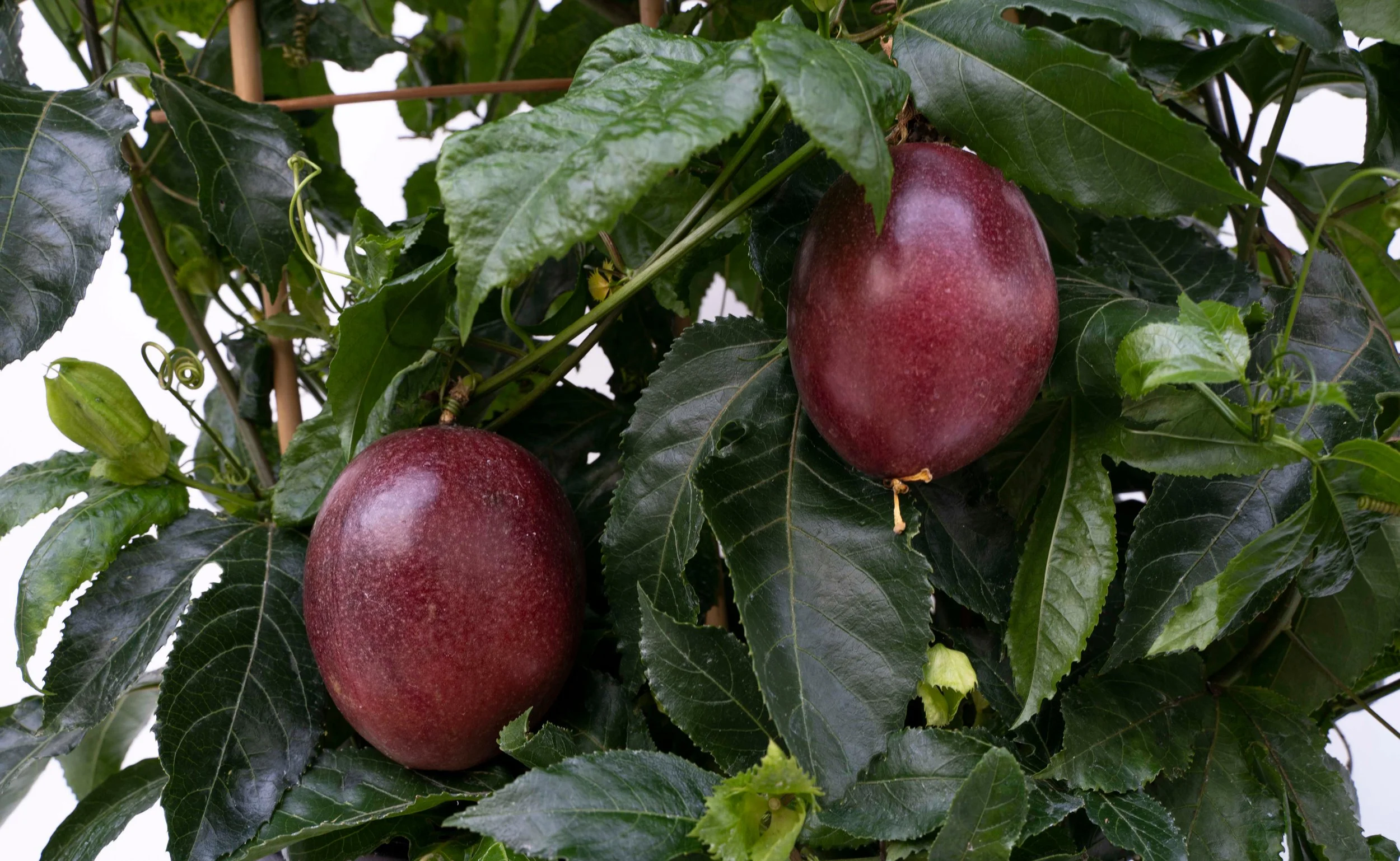
Poppin’ Passion™ performs best in moderately acidic to neutral soil with a pH of 5.7–6.8. This plant is sensitive to long periods of extensive watering and prefers well-draining soil and a drier growing environment. Grow in full sun to part shade.
All the varieties in the Bushel and Berry® collection will thrive in patio pots, edible gardens, or in the landscape for years of enjoyment. We recommend planting this variety in a large container, 16–22” in diameter with a trellis to train the vining habit.
Plant In Container
Choose a container (16” in diameter and at least 10” deep is ideal).
Fill ⅔ of the container with regular potting soil.
Add plant to pot, gently loosening the roots of the plant.
Fill in soil around plant with regular potting soil.
Insert a trellis into the soil behind the plant, being careful of the roots. Gently weave the vine onto the trellis to support the plant’s upward growth. Monitor and adjust this support as needed.
Place plant in a sunny spot. It will need at least 6 hours of full sun each day.
Water the plant frequently, ensuring it stays moist but not overwatered.
Plant IN GROUND
Pick a spot that receives at least 6 hours of full sun each day.
Dig a hole slightly larger than the container. Work the soil at the bottom of the hole with your shovel so that it’s loose and aerated.
Remove the plant from its container. Use your hands to gently loosen the roots at the bottom of the plant.
Place your plant in the hole, ensuring that the base of it is level with the soil.
Add soil back to the hole around the plant. Crumble the soil so that it’s nice and aerated. If desired, mulch around the plant.
Insert a trellis into the soil behind the plant, being careful of the roots. Gently weave the vine onto the trellis to support the plant’s upward growth. Monitor and adjust this support as needed.
Water your plant thoroughly around the base, allowing it to soak in. Continue to water 2–3 times a week, ensuring that the plant stays moist but not overwatered.
FERTILIZING
Passion fruit plants are heavy feeders and will greatly benefit from regular fertilization. Fertilizer can be applied in the spring and the summer and decreased in the fall so as not to encourage new growth through the winter. Any all-purpose, balanced fertilizer will work.
WATERING
The amount of water your plant needs will depend on your climate. In general, make sure the plant has consistent moisture but isn’t overwatered. This usually means watering 2–3 times a week for plants in the landscape, and every 1–2 days if it’s in a container. Passion fruit plants prefer a drier growing environment, so be careful not to overwater.
Tip: Remember, plants and their roots in patio pots dry out faster than plants in-ground, especially on warm summer days. A good way to gauge your watering is to water until you see runoff coming out of the drainage holes.
PRUNING
Passion fruit vines can be trimmed to control size or left to grow along a fence or trellis. This plant is a vigorous grower, so it can be pruned hard and rejuvenated if needed. When pruning, the best time is late winter/early spring before new flowers begin to form. Dead or damaged vines can be removed at any time.
WINTER CARE
Poppin’ Passion™ is hardy in zones 9–11 and can be grown outdoors year-round in those regions. However, this plant can be grown in a container outside of its hardiness zones and overwintered indoors. Here is the best way to overwinter your passion fruit plant indoors:
Before your first frost date (average date when temperatures reach 32°F), move your passion fruit inside in a warm, well-lit area. Placing your plant near a window is a good spot. In general, you will treat your passion fruit like a houseplant over the winter – it will not go dormant.
If your passion fruit is trained on a trellis in the container, you can move the whole plant indoors without any trimming or pruning. However, if your plant is growing on an outdoor structure like a fence, or if it is too large for the space you have inside, you can trim the vines.
If trimming the vines, you can make your cuts as far down as you like, as long as you leave at least four leaves so the plant can continue to photosynthesize. Passion fruit vines are vigorous growers, so it will have no trouble growing back to a full size.
Continue to water your passion fruit regularly through the winter, being careful not to overwater or let the plant dry out.
After the frost-free date in your area, you can return your passion fruit to an outdoor location and continue growing all summer.